Scientific Advisory Board
International Expertise
In 2003, the Academic Alliance (AA) created an International Scientific Advisory Board (SAB) chaired by Paul Volberding, M.D. to give direction to the AA's training, research and clinical programs. This panel of world-renowned scientists from the U.S., Canada, Europe and Africa continue to provide expert guidance and critical international perspectives on Accordia Global Health Foundation’s current and future initiatives. These academician-physicians also spend time working with the staff, trainees and young scholars at Accordia’s flagship program, the Infectious Diseases Institute (IDI), guiding them in their research and practices as well as providing ongoing support and mentorship.
- Joep Lange, MD, PhD
- Fred Mhalu, MD
- Mairin Ryan, MD
- Cathy Wilfert, MD
Paul Volberding, MD, CHAIR
Dr. Paul Volberding is a Professor and Vice Chair of the Department of Medicine at the University of California, San Francisco, and Chief of the Medical Service at the San Francisco Veterans Administration Medical Center. He received his undergraduate and medical degrees at the University of Chicago and the University of Minnesota, respectively, and finished training at the University of Utah and the University of California, San Francisco, where he studied for two years as a research fellow in the virology laboratory of Dr. Jay Levy, later a co-discoverer of HIV. For twenty years, Dr. Volberding’s professional activities centered at San Francisco General Hospital where he established a model program of AIDS patient care, research, and professional education. His research career began with investigations of HIV-related malignancies, especially Kaposis Sarcoma. His primary research focus, however, shifted to clinical trials of antiretroviral drugs. He has been instrumental in testing many compounds, including early studies in asymptomatic infection that lead to the concept of HIV disease, not simply AIDS as the target of treatment. Dr. Volberding has written many research and review articles. He is the co-editor in chief of the Journal of Acquired Immune Deficiency Syndrome, and a founder of HIV InSite, a comprehensive source of HIV information. He is the founder and Chair of the Board of the International AIDS Society - USA. He also served as President of the HIV Medical Association. He was elected a member of the Institute of Medicine of the National Academy of Sciences in 1999.
David Bangsberg, MD

David Bangsberg, MD is an Associate Professor in the Partner AIDS Research Center at Massachusetts General Hospital with appointments in the Harvard School of Medicine. He completed medical school at Johns Hopkins Hospital in Baltimore, his internal medicine residency at Columbia Presbyterian Hospital in New York, and Fellowships in Infectious Disease and AIDS Prevention at the University of California, San Francisco. Dr. Bangsberg’s research focuses on HIV in impoverished populations. In 1996, Dr. Bangsberg launched a series of studies in HIV+ homeless and marginally housed individuals in response to concerns that poor adherence to HIV antiretroviral treatment in the urban poor would create new strains of drug resistant virus. These studies mitigated what we now recognize were exaggerated concerns regarding HIV drug resistance in the urban poor and helped shift the debate from withholding treatment to maximizing treatment effectiveness. In 2001, Dr. Bangsberg launched a series of studies to address similar concerns that the scale-up of antiretroviral therapy to poor regions of the world would similarly lead to unacceptable levels of drug resistance due to the challenges of adhering to antiretroviral therapy in settings of extreme poverty. Contrary to popular opinion, Dr. Bangsberg found that HIV+ people living in sub-Saharan Africa are better able to adhere to antiretroviral therapy than their counterparts in North America. This work was deemed by the editors of The Lancet as among the most important medical findings for 2006 and was described by President Bill Clinton at the “nail in the coffin “on the debate as to whether poor people living in Africa can successfully take their HIV treatment. Dr. Bangsberg founded and continues to lead the HIV research program at the Mbarara University of Science and Technology in Mbarara, Uganda. This program focuses on structural barriers to treatment access and treatment adherence, including transportation to health care settings as well as the competing demands of securing food for HIV+ individuals and their families. In addition to faculty appointments at Harvard Medical School and Massachusetts General Hospital, Dr. Bangsberg is Senior Research Scientist at HIGH and will direct the Global Health Scholars Program. The overarching goal of this new program is to cultivate the next generation of global health leaders by engaging faculty and scholars from across the University and the globe to address the world’s greatest challenges in health sciences. Dr. Bangsberg has received research awards from charitable foundations, the National Institutes of Health and the Centers for Disease Control. He was the second highest ranked National Institute of Health RO-1 funded investigator in HIV/AIDS in 2007. He is on the Editorial or Advisory Boards of PLOS Medicine, JAIDS, AIDS Patient Care and STDs, AIDS Care and AIDS and Behavior. He has authored or co-authored over 120 publications in peer-reviewed journals, and several book chapters.
John Bartlett, MD
John G. Bartlett, MD, is a Professor of Medicine in the Division of Infectious Diseases at The Johns Hopkins University School of Medicine, Baltimore, Maryland. He served as Chief of the Infectious Diseases Division at the School for 26 years, stepping down in June of 2006. Dr. Bartlett received his undergraduate degree at Dartmouth College, Hanover, New Hampshire, and his medical degree at Upstate Medical Center, Syracuse, New York. He trained in internal medicine at the Peter Bent Brigham Hospital, Boston, Massachusetts, and the University of Alabama, Birmingham, and he completed his fellowship training in infectious diseases at the University of California, Los Angeles (UCLA). Before accepting his current position at The Johns Hopkins University, Dr. Bartlett served as a faculty member at UCLA and Tufts University School of Medicine in Boston, Massachusetts, and was associate chief of staff for research at the Boston VA Hospital. Dr. Bartlett has worked in several areas of research, all related to his specialty in infectious diseases. His major research interests have included anaerobic infections, pathogenic mechanisms of Bacteroides fragilis, anaerobic pulmonary infections, and Clostridium difficile-associated colitis. Since moving to Johns Hopkins, his major interests have been HIV/AIDS, managed care of patients with HIV infection, and bioterrorism. Dr. Bartlett is a member of the Institute of Medicine, a master of the American College of Physicians, past president of the Infectious Diseases Society of America (IDSA), and a recipient of the Kass Award from the IDSA. In 2005, Dr. Bartlett was awarded the Alexander Fleming Award by the IDSA and the Finland Award from the National Foundation for Infectious Diseases (NFID). Dr. Bartlett has authored over 500 articles and reviews in peer-reviewed journals, more than 280 book chapters, and 67 editions of 18 books. He has served on editorial boards for 19 medical journals.
Nick Hellmann, MD
Dr. Nick Hellmann joined The Bill and Melinda Gates Foundation in June 2005 and is currently the Interim Director for HIV/AIDS, Tuberculosis, and Reproductive Health. In this role Dr. Hellmann’s team is responsible for oversight and grant making for all projects related to these health areas as the Foundation strives to reduce health inequities in the developing world. Prior to joining The Foundation staff, Dr. Hellmann was the Chief Medical Officer at Roche Molecular Systems, the global leader in the development of nucleic acid-based diagnostic tests for individualized clinical management of human diseases. In his role, Dr Hellmann provided medical oversight and input, from product concept through product commercialization, for all RMS marketed and developmental molecular diagnostic tests. Prior to joining Roche, Dr. Hellmann was the Vice President of Clinical Research from 1997-2003 at ViroLogic, Inc., a leading company in the development of therapy guidance technologies related to evaluation and management of drug resistance in serious viral infections, such as HIV and hepatitis. While at ViroLogic, he directed the clinical research and clinical laboratory activities that led to the commercialization of the company’s novel drug resistance technologies and authored numerous publications related to epidemiology of viral drug resistance and clinical utility of drug resistance tests in patient management. Prior to joining ViroLogic, he held positions at biotechnology and pharmaceutical companies, including Gilead Sciences, Genentech, and Bristol-Myers Squibb, where he directed clinical research activities related to the development of novel antiviral and antimicrobial drugs. Dr. Hellmann completed his Internal Medicine Residency and Infectious Diseases Fellowship training at the University of California, San Francisco after receiving his MD degree from the University of Kentucky in 1982. After completion of his fellowship training in 1988, Dr. Hellmann was an Assistant Professor in the Internal Medicine/Infectious Diseases Division at the University of California, San Francisco and was an Infectious Diseases Consultant in a private medical practice. While on the Department of Medicine Faculty at UCSF, Dr Hellmann lived and worked in Uganda, East Africa from 1989-1991 on the Makerere/UCSF Collaborative Health Project to identify factors, such as STIs, circumcision status, and sexual behaviors, associated with heterosexual transmission of HIV infection and to develop appropriate intervention strategies to reduce HIV transmission.
David Durack, MD
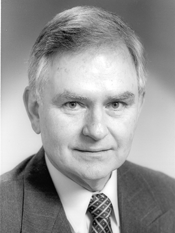
Dr. David T Durack is Senior Vice President, Corporate Medical Affairs and Director of Pre-Clinical and Clinical Development for BD (Becton Dickinson), and Consulting Professor of Medicine at Duke University. He graduated from University of West Australia Medical School ’69, and undertook postgraduate studies at Oxford University ’70 -’73 as a Rhodes Scholar, leading to Doctor of Philosophy ’73. His doctoral thesis was titled "Experimental Endocarditis". He held internship and residency posts at the Radcliffe Infirmary, Oxford with further training at the Royal Post-graduate Medical School, Hammersmith Hospital, London. His research has centered on host-parasite interactions and chemotherapy of bacterial and fungal infections. For 17 years he was Chief of the Division of Infectious Diseases and International Health at Duke University. He is a Fellow of the Royal College of Physicians (UK), the Royal Australasian College of Physicians, and the American College of Physicians; he has published more than 200 articles and textbook chapters and co-edited several textbooks. Dr. Durack has been elected to the American Society for Clinical Investigation, the Council of the Infectious Diseases Society of America, and the American Academy of Microbiology. He has served on an FDA Review Panel, as Chairman of the Board of Directors, ASM Resources Inc., and as a Director of Joint Commission Resources.
Howard Jaffe, MD

Dr. Jaffe is President and Chairman of the Board of the Gilead Foundation. A graduate of Cornell University, Dr. Jaffe received his medical degree from the Yale University School of Medicine in 1982.After completing his Internal Medicine Residency and Oncology Fellowship training at the University of California, San Francisco he joined the UCSF faculty. In 1986, Dr. Jaffe joined the staff of Genentech, where, as Director, Clinical Research, he played an important role in the development of protein-based therapeutics, including interferon-gamma (Actimmune) and the anti-HER-2 monoclonal antibody (Herceptin). In 1991, Dr. Jaffe joined Gilead Sciences where he has been a member of Gilead’s senior management team including roles as Chief Medical Officer and Senior Vice President, Drug Development. Under his leadership, Gilead has become a global leader in the development of small molecule therapeutics for the treatment and/or prevention of important viral pathogens including tenofovir disoproxil fumarate (Viread for HIV), adefovir dipivoxil (Hepsera for HBV), cidofovir (Vistide for CMV), and oseltamivir (Tamiflu for influenza). From 2002 to 2004, Dr. Jaffe also served as Research Director at the Gordon and Betty Moore Foundation.
King Holmes, MD

Dr. Holmes, Professor of Medicine, directs the University of Washington (UW) Center for AIDS and STDs, which involves 245 UW-affiliated faculty and research scientists and 85 pre- and post-doctoral trainees; and heads the Infectious Diseases Section at Harborview Medical Center in Seattle, Washington. He is the principle investigator for two NIH Center grants (the UW Center for AIDS Research and the UW STI Cooperative Research Center), and for two UW AIDS/STD research training programs. He has participated in research on STIs in developing countries for 40 years, and in research, training, and technical assistance on HIV/AIDS and other STIs in Africa, Latin America, SE Asia, and the Western Pacific for over 20 years. He has participated in the design and conduct of 6 randomized controlled trials of STI prevention, the most recent a trial of expedited treatment of sex partners of patients with gonococcal or chlamydial infection, which demonstrated a 75% decrease in persistent or recurrent gonococcal infection in the index patient (M. Golden, NEJM, 2005). He currently leads a randomized trial of topical microbicide use by men in fishing communities on Lake Victoria for prevention of STI/HIV acquisition, and a Welcome Trust/NIH-funded 20-city randomized trial of STD/HIV prevention in Peru. He has authored over 470 peer-reviewed publications and edited 30 journal supplements and books. He serves as PI of the UW/UCSF International Training & Education Center on HIV (I-TECH), funded by the US government to provide training and support for HIV/STI management, care, and prevention in 13 countries. He has trained and/or mentored over 100 scientists involved in HIV/STI research and care in the US and other countries throughout the world, several of whom (e.g., Larry Corey, Judy Wasserheit, Sharon Hillier) are active in the clinical trials network leadership.
Joep Lange, MD
Professor Lange is an internist by training with an extensive background in HIV care, clinical trial design and implementation, clinical and research site training, and policy making with regard to HIV related issues, including MTCT interventions. In these capacities, and while with WHO, as Chief of the Clinical Research & Drug Development (later Clinical Research and Product Development) Global Programme on AIDS, from 1992-1995, he has worked in many nations in South-America, Asia and Africa. Prof. Lange has been the principal investigator for more than 30 trials on antiretroviral therapy. He has been an editor for a.o. AIDS, and is Editor-in-Chief of Antiviral Therapy, and is author/co-author on more than 200 publications in peer-reviewed scientific journals and of several chapters of books on HIV infection and antiretroviral therapy. Professor Lange holds a professorship in Medicine, in particular viral infections, at the Academic Medical Center (AMC), University of Amsterdam, The Netherlands, and is Head of the HIV/AIDS Outpatient Clinic of the AMC. He is director of the National Therapy Evaluation Centre (NATEC), and Chief Scientific Adviser and Director of the International Antiviral Therapy Evaluation Center (IATEC), one of the leading organizations for clinical research into prevention and treatment of HIV and other viral infections. He is the Founder and Chairman of PharmAccess International Foundation, a not- for-profit organization active in the health sector, with a focus on HIV/AIDS therapy in resource-poor countries, offering a modular set of products, services, and tools to initiate, implement, and manage treatment programs. Other national positions he holds are: Chairperson of the Scientific Advisory Board HIV Monitoring Foundation Netherlands (SHM), Member of the Executive Committee Amsterdam Cohort studies on HIV/AIDS, and Member of the Scientific Advisory Board Dutch AIDS Fonds. In addition to the above, his international functions are: Co-director of the HIV Netherlands Australia Thailand Research Collaboration, Bangkok, Thailand, Immediate Past President of the International AIDS Society (July 2004), Co-Chair of the XV International AIDS Conference in Bangkok (2004), Member Partner of The Advisory Group Forum WHO ‘3 by 5’ Initiative, Member of the Writing Committee WHO HIV Treatment Guidelines, and Member of WHO Strategic and Technical Advisory Committee for HIV/AIDS (STAC-HIV).
Cathy Wilfert, MD
Dr. Wilfert is currently Scientific Director at the Elizabeth Glaser Pediatric AIDS Foundation. She was Professor and Chief of the Division of Pediatric ID at Duke for 13 years. In 1986 she became one of the first investigators in the field of Pediatric HIV/AIDS. Her group at Duke was the very first to study the effects of antiretroviral therapy in HIV-infected children. Implementation of her concept of interruption by maternal AZT therapy of HIV transmission from mother to infant has reduced infant infections by more than 80% in the USA. In the year 2000 she was President of the Infectious Diseases Society of America, and was elected to membership in the Institute of Medicine of the National Academy of Sciences. The private and federally funded Call To Action program of the Elizabeth Glaser Pediatric AIDS Foundation reaches 19 countries and over 500 clinics. It has provided access to PMTCT services for over a million women in antenatal clinics in the developing world in 3 years and provided access to antiretroviral prophylaxis for the 91,000 HIV + women. Currently, Dr. Wilfert is also working to expand services to provide care and support including antiretrovirals to HIV infected families including children in the developing world with PEPFAR funding awarded to the Foundation.
Latest News

- 2010 Infectious Diseases Summit Concludes in Dar es Salaam
- Attendees Dive into Evaluation Challenges on Day Two of the Accordia Infectious Diseases Summit
- Kaiser Daily Global Health Policy Report: WHO Advises Continued Use Of GSK's Rotavirus Vaccine In Developing Countries
- Kaiser Daily Global Health Policy Report: Sec. Clinton Highlights Water As Diplomatic, Development Opportunity For U.S.
Donate Now
Your support will mean a healthier future for Africa. Our programs and services can only reach their full potential through the generous support of our partners and donors.
Sign up for our Newsletter
Join our email list to receive The Alliance newsletter and occasional updates from Accordia Global Health Foundation.