Accordia Spotlight
Improving HIV Care in Her Local Community
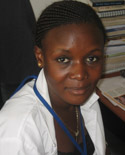
“Compassion and kindness,” she said. Three simple words softly spoken. Yet, powerful and clear. It wasn’t a statement necessarily about herself, but a response to the question:“What does it take to be an effective health care worker in the HIV community in Africa?” Brilliance, to understand an incredibly complex and debilitating disease with equally challenging drug regimens? Mental toughness, to endure the heartbreaking stories undoubtedly communicated on a daily basis by patients? Optimism? No…compassion and kindness… The response itself spoke volumes about Dr. Olivia Kharono, a clinical officer at the Joint Clinical Research Center (JCRC) in Mubende who recently completed training in advanced HIV/AIDS care and prevention at the Infections Diseases Institute in Kampala.
Since graduating from Fort Portal School of Clinical Officers in 2005, Dr. Kharono has worked in areas heavily impacted by HIV/AIDS. Clinical officers, nurses and other mid-level practitioners are increasingly taking on tasks conventionally assigned to doctors, as they outnumber them by 6:1 in these settings. Recognizing the need to increase her skill set and better address the needs of her patients, Dr. Kharono sought out training at the Infectious Disease Institute in 2008. IDI was one of the first training centers to offer training in advanced HIV/AIDS care and prevention to clinical officers. “There were several reasons both personally and professionally I chose to attend IDI. First, I wanted to improve the quality of life for my patients. I also wanted to perfect my clinical skills by learning drug regimens and toxicities in order to prescribe medicine. Because of IDI, I do that now for my patients and am a more effective practitioner.”
In a clinic like JCRC, Mubende, which treats over 6,383 patients and has initiated ART for over 1,652 of them, more trained professionals improves the quality of the clinic overall. “At IDI, I learned to really take time with patients; to put down the pen and really listen. And I have used the training to pass on information to my colleagues. We are task-shifting what we know to others so we can manage more activities. In that way, the whole health center improves.”
Of her patients, Dr. Kaharono said, “There are many poor people here who survive on less than two dollars a day. We treat quite a few soldiers and most of our patients are women, widows and children who fear disclosure. There remains a huge stigma in our community where women hide their medication underneath their baskets. We are their only hope.”
Latest News

- Uganda: Adolescents Living With HIV/Aids Find Solace
- Accordia Calls on G8 Leaders to Invest in Strengthening Healthcare Systems
- CNN HIV/AIDS: 'Dawn of a new era' for AIDS in South Africa?
- Kaiser Daily Global Health Policy Report: Leaders Respond To World AIDS Day; South Africa To Expand HIV Treatment Program
Donate Now
Your support will mean a healthier future for Africa. Our programs and services can only reach their full potential through the generous support of our partners and donors.
Sign up for our Newsletter
Join our email list to receive The Alliance newsletter and occasional updates from Accordia Global Health Foundation.